November 22, 2013

Review: Austenland by Shannon Hale


Austenland by Shannon Hale
Published: 2010, Bloomsbury USA
Series: Austenland, #1
Genre: Adult Romance, Contemporary
Source: Purchased
Goodreads · Amazon · Barnes & Noble


At a very young age, she had learned how to love from Austen. And according to her immature understanding at the time, in Austen’s world there was no such thing as a fling. Every romance was intended to lead to marriage, every flirtation just a means to find that partner to cling to forever.


Jane Hayes has a bit more than a healthy appreciation of Jane Austen’s works. What Jane Hayes has could actually be more easily classified as an obsession. It’s caused her to have unrealistic expectations of today’s men, and she’s not the only one who has come to that realization.

From her great aunt’s will, Jane learns that she has been given an all-inclusive three week vacation to Pembrook Park, a place that reenacts life in Regency England for paying customers. Jane decides to allow herself three weeks of pure wish-fulfillment at Pembrook before ending her Austen (more specifically Mr. Darcy) obsession.

Despite possessing a strong appreciation of Jane Austen, I haven’t read many stories that pay homage to her works. After quite enjoying a few of Hale’s other works, I decided to give this one a try. I can relate to wish-fulfillment and the desire to experience life from a different era. And as Jane herself says best:
“If you were a woman, all I'd have to say is 'Colin Firth in a wet shirt' and you'd say 'Ah.’”
I enjoyed the intermixing of reality and fantasy, true depth and superficiality. As much as Mrs. Wattlesbrook, the proprietress of Pembrook Park, tries to replicate an authentic Regency experience, the experience is only as good as the people participating in it. Newly christened as Jane Erstwhile, it does not take Jane long to realize that, much as she’d like for it to be real, she’s simply interacting with actors and other people who possess sad addictions to the lifestyles found in Jane Austen’s stories, and that she’s one of them.

My main complaint is that Jane simply isn’t very memorable, nor are any of the relationships she’s had. Between each chapter, Hale adds short sections recounting Jane’s history with her thirteen past boyfriends. These sections were surely intended to help readers form a better understanding of what caused the severity of Jane’s Austen-like romantic ideals. And perhaps they do to some degree, but they do not help develop Jane’s character in any substantial way.

Nor is Jane’s transformation as satisfying as it could have been. From Jane’s first misgiving during her three-week stay at Pembrook Park, I had a pretty good guess of where the story was heading and how being there would ultimately affect Jane’s development. Expecting certain events to occur did not necessarily hinder my enjoyment of those events while I was reading. Jane’s lack of solid characterization did, however. Besides her obsession with Jane Austen’s works, I had trouble understanding her character. She finds herself involved in flirtations with two men, and she wants each of them to see her as herself, not as Miss Jane Erstwhile. And yet even I as a reader had trouble determining exactly what makes Jane tick.

This is the first book I’ve read by Shannon Hale that caters to an adult audience. While amusing, this story lacks much of the charm I found in The Goose Girl and Princess Academy. From what I’ve read of Hale so far, I think she’s better at writing for children and young adults. That being said, this will not be my last Hale book; it is likely, however, that this will be the last adult book I read from her.

Despite all my criticism, I did enjoy my time spent reading Austenland. It functions well as a work of fun, light-hearted chick lit, and reading this was a perfect break from a project I had. It’s pure escapism, just as Pembrook Park itself is supposed to be. But any deeper meanings fell flat for me. I suppose this is worth the read, but it’s not really worth spending any more time thinking about it once the last page is closed.

Rating: 2.5 stars


Read more »

November 20, 2013

Review: Belle Epoque by Elizabeth Ross


Belle Epoque by Elizabeth Ross
Published: 2013, Delacorte Books for Young Readers
Genre: Young Adult Historical Fiction
Source: Library
Goodreads · Amazon · Barnes & Noble


“In Paris, everything’s for sale: wise virgins, foolish virgins, truth and lies, tears and smiles.”
- “Rentafoil,” Emile Zola


So begins Emile Zola’s short story “Les Repoussoirs” (“Rentafoil” in English), which tells the story of how Monsieur Durandeau creates a business through commodifying beauty. He notices the many struggles that women undergo in order to appear their best, through clothing and hairstyles and expensive jewelry. While so many businesses catered towards making attractive women more attractive, no businesses direct their services to those less attractive women. Durandeau therefore positions himself to fill that void by forming a business where ugly women help beautify their prettier (and wealthier) patrons.

Although this review will focus on Elizabeth Ross’ historical fiction novel Belle Epoque, her book is heavily influenced by Zola’s short story, so I first wanted to put it into context. Ross slightly modernizes the time period: her story takes place at the end of the nineteenth century, instead of the mid-nineteenth century. But Ross essentially adopts Zola’s idea and expands upon it. Fortunately, I was made aware of the influence Zola’s short story had on Belle Epoque before I read this, so that I could first read Zola’s story. Ross credits Zola for the inspiration in a note at the end, but I do wish that influence was made more apparent earlier on in the book. I encourage other readers to read Zola’s very brief short story before Ross’ book.
After hearing that her father wishes to marry her off to the much-older butcher of their provincial French town, Maude Pichon decides to run away and start a new life in Paris, city of dreams and possibilities. Unfortunately, Paris is also an expensive city and as her savings dwindle Maude becomes desperate for work. This desperation leads her to Monsieur Durandeau’s agency in answer to an ad asking for “young women wanted for undemanding work.” Although at first she spurns a job offer based entirely on her “plainness,” Maude soon realizes that no other jobs can compete with with Durandeau offers: beautiful dresses, high-society events, lavish meals, days spent accompanying the wealthy about town. And so Maude reluctantly becomes a repoussoir.

Good timing lands Maude a regular position as the companion to Countess Dubern’s daughter Isabelle. The countess needs all the help she can get for her daughter’s first season, and hiring a repoussoir is just one of the many steps she takes to ensure that her daughter will end the season with a marriage offer. Maude becomes the employee of the countess, Isabelle unaware that Maude is anything but a family friend’s distant relation. Neither of them expected a friendship to form. As Maude starts seeing Isabelle as more than a spoiled rich girl, however, she’s faced with the conflicting loyalties.

I am always interested in a story that encourages a discussion on beauty and the different roles it plays in society. This makes up the heart of Belle Epoque and this is where the story really shines. Maude initially turns down an offer with Durandeau’s agency and is shocked that the women allow themselves to be so degraded. Whenever a customer requests a repoussoir for the day, all the women are forced to line up, allowing Durandeau to discuss with the potential customer each of their flaws. Maude is unique in that she’s considered more plain than ugly, but she also falls prey to the sense of hopelessness and lack of self-worth that all the repoussoirs feel. In this story about those oppressed by their apparent lack of beauty, Ross is able to really examine different constructs of what beauty is and how people view it.

I read that a large part of the reason that Ross decided to have her story take place in Belle Epoque Paris was due to the historical context that the World Exposition and Eiffel Tower provided. Although the parallels between the places that both it and “ugly” women occupy in Paris are fairly heavy-handed, I still enjoyed this added context to the book’s main discussion on beauty conventions. Taking into account the sense of romance and nostalgia that images of the Eiffel Tower have in our current society, Ross’ purpose in including the original disdain and ill-will that the Parisians initially have towards its creation becomes very clear.

Besides the discussion of beauty conventions, Belle Epoque is also a wonderfully compelling story of a friendship developed between two girls who occupy very different worlds. Physically and economically, Maude and Isabelle are nothing alike. And yet, their hopes and dreams allow them to discover things about themselves and each other that they are too afraid to otherwise admit. Isabelle is the more dynamic character, fighting against the chokehold of societal expectations. She doesn’t care about propriety, about looking beautiful, about finding a husband; instead, she wants to attend the university and study science. While reading this story, I found myself wondering what it would have been like to have Isabelle as narrator. In comparison to Isabelle, Maude is more timid, less confident in what she wants to do with her life. And yet Maude becomes a more relatable character over time, gaining both confidence and self-worth. It was so rewarding to witness how their friendship and trust in one another allows each girl to ultimately take control of her own life.

Through a critique on beauty, societal standards, and the place of women, among other things, I found Ross’ decision to include a romance, sweet as it is, to be a little disappointing. Nothing is technically wrong with Maude’s growing attraction for Paul, an aspiring musician from the lower class. At times, Paul’s character seems to function as a moral compass for Maude, reminding her that beauty is more than skin-deep, and also that it’s okay for her to want better things with her life. As I said before, their romance is sweet, but I do think that Isabelle and the other repoussoirs could have just as easily helped Maude come to that ultimate conclusion.

A few nitpicky issues aside, I found Belle Epoque to be a well written work of fiction. Besides the parts about the Eiffel Tower and mentions of living situations, I didn’t a super strong sense of the historical time period, but that ultimately isn’t what this story is about. Belle Epoque addresses timeless issues concerning beauty as a superficial means of status. I enjoyed the discourse on beauty, and I absolutely loved the focus on Maude and Isabelle’s friendship. Highly encouraged for fans of historical fiction who are looking for a more unconventional type of story.

Rating: 4.5 stars

Read more »

November 18, 2013

Review: Pawn by Aimée Carter


Pawn by Aimée Carter
Series: The Blackcoat Rebellion, #1
Published: November 26, 2013, Harlequin Teen
Genre: Young Adult Dystopian
Source: Publisher via Netgalley
Goodreads · Amazon · Barnes & Noble


“They may be weak when the game begins, but their potential is remarkable. Most of the time, they’ll be taken by the other side and held captive until the end of the game. But if you’re careful--if you keep your eyes open and pay attention to what your opponent is doing, if you protect your pawns and they reach the other side of the board, do you know what happens then?”
I shook my head, and she smiled.
"Your pawn becomes a queen." 


Five years after The Hunger Games released, YA dystopian literature is still going strong. I get its appeal and why it continues to resonate with readers. While not my favorite genre, I still tend to enjoy the dystopians I read. At least, I enjoy those works of dystopian literature that stay true to their purpose of providing critiques of  social and political structures of futuristic societies. Nothing infuriates me more than a poorly constructed or subdued dystopian world that has little purpose beyond creating obstacles for star-crossed lovers.

Fortunately, Pawn by Aimee Carter places political and social criticisms as first and foremost in its story. It may not be the most unique offering to YA dystopian literature, but I still found it entertaining and well done overall.

For the past seventeen years, Kitty Doe has grown used to the fact that she’s expendable. She is the unwanted (and illegal) second child of lower-rank parents who have since died. Because of this, she’s grown up in a orphanage for second children, referred to as Extras. Besides her relationship with her best friend Benjy, a fellow orphan and an Extra, Kitty’s been fixated on her seventeenth birthday. In her futuristic United States, people are given a test on their seventeenth birthdays which determines their societal rank from I to VI and their future occupations.

Kitty, with her limited educational resources and reading problems, was doomed to fail from the start. She’s grown up believing in the system’s fairness, however, and thinks her determination to succeed will be enough. The III emblazoned on the back of her neck is not only a shock to her, but she sees it as a declaration of her unworthiness. Most of all, she sees it as confirmation that she and Benjy (a sure VI) will never work out. So when Prime Minister Hart offers her the chance to become a VII, to enjoy a life of wealth and comfort beyond her wildest dreams, Kitty accepts.

Of course, Kitty has no idea the repercussions of the bargain she just made. Only members of the ruling Hart family can have the VII rank, and to become one of them Kitty is masked quite literally, turned into the recently-deceased niece of the Prime Minister, Lila Hart. And her life, which would have been restrictive as a III, becomes even more so as she must give up her old attachments for a brand new life she cannot leave.

Honestly, the reason I was able to enjoy this book to the extent that I did is directly related to Kitty’s first person narration. As I’ve mentioned before, dystopian literature is fairly common, and Carter employs many well-known tropes in her story. Perhaps a bit reminiscent of Katniss, Kitty is naive and initially unwilling to do something about the problems in her world. She’s also a bit too trusting, pigheaded, and backs off of conflicts too easily. Because of these qualities, I found that she was the perfect narrator to introduce readers to her world. Readers who are overly familiar with the intrigue and rebellions between the “haves” and “have nots” of dystopian literature are almost forced to slow down and really appreciate Kitty’s consternation as she finds affirmation after affirmation that nothing is as it seems. These revelations are huge in her understanding of the world, which jaded dystopian readers should keep in mind.

The central conflict in Pawn is not really a rebellion, however. Kitty is more than simply a heroine reluctant to assume the burden of responsibility; her purpose throughout the novel is consistent: find a way to ensure that Benjy is given the life he deserves. She falters here and there, but Benjy acts as a beacon of hope that some things in their life will work out as they should. Benjy has always deserved to gain a high ranking, and Kitty works to ensure that nothing she or anyone else does prevents him from achieving his potential. Pawn starts out with Kitty and Benjy in a committed, long-term relationship, which was actually a nice change from a focus on the throes and drama of a new romance. Not even Lila’s fiancé Knox can throw a wrench into their relationship.

Perhaps the least successful part of this novel was the in depiction of the rebellion and Lila’s role in it. Although Kitty is supposed to be Lila, I never had a good understanding of who Lila was. Her presence in the rebellion was similarly undefined, although Kitty’s interactions with other sympathetic Hart family members begin to shed a bit of light on that. Through her new life as Lila, readers are able to witness the effect of the revolution from the other side: the side of the enfranchised. Readers are also able to see the stark differences in life for the highest class and the lowest of lows (Kitty may not be a I, but she’s an “Extra” in a society that has a strict set of predetermined rules and behaviors for people to follow). The various ways that Carter allows her readers to view the rebellion are interesting, to say the least.

Outside of the rebellion itself, the rest of the political intrigue felt a tad...overzealous of Carter? Literally every single character has incriminating secrets and ulterior motives. Perhaps Carter is simply trying to detail Kitty’s loss of naivety, but it was a bit frustrating for me to see Kitty come to the same conclusion again and again: no one can be trusted. She needs to trust herself. This message is repeated throughout the novel ad nauseam. At least Kitty’s naivety is fairly consistent.

Nothing that Carter has done with Pawn is truly groundbreaking for dystopian literature. But that’s all right. I don’t believe every novel necessarily has to advance its genre. Pawn is entertaining and has some fairly thought-provoking perspectives on rebellion and identity. While I don’t necessarily feel like reading through Carter’s backlog, I will be continuing on with this series.

Rating: 3.5 stars

Disclaimer: I received this review copy from the publisher, but that in no way affected my opinion. The quote is from an advanced copy of the novel and is subject to change in the final edition.  

Read more »

November 15, 2013

Ready to Become a Fan of...Catherynne M. Valente


It's the sad truth that one lifetime will never be enough to read every book I'd like to read. This was true even before I became a book blogger, and since then the number of authors whose books I'd love to read has expanded exponentially. Shiny new books, easy-to-access library books, and even merely the stresses of everyday life have all contributed to my ever-growing pile of unread authors I really do intend to read.

Thus this feature was born. Ready to Become a Fan of... focuses on those authors new and old whose works I have every intention of eventually reading, but haven't been able to devote the time to just yet. By discussing authors and their works that I'm sure I'll love, given the chance, hopefully I can be more easily compelled to take the next step in not simply acquiring one of their books, but actually take the time to read it.

This month I'm putting on record that I am ready to become a fan of Catherynne M. Valente.

About the author:

Catherynne M. Valente has written more than a dozen fantasy and science fiction novels in the past decade. She seems to be best known for her current Fairyland series (The Girl Who Circumnavigated Fairyland in a Ship of Her Own Making was #8 on the New York Times bestseller list in 2011 and trilogy’s finale, The Girl Who Soared Over Fairyland and Cut the Moon in Two, was published this past October). Her works have garnered accolades such as James Tiptree, Jr. Award, the Mythopoeic Award, Andre Norton Award, and Locus Award. In addition to her novels, Valente has published poetry collections, short stories, and literary criticisms. 


Work I'm most looking forward to reading:
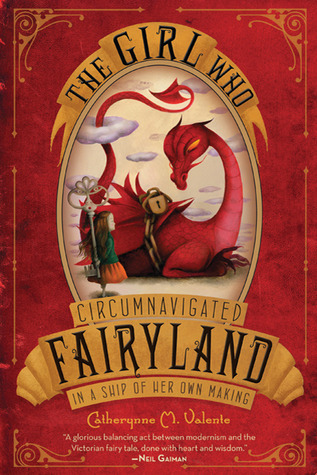
The Girl Who Circumnavigated Fairyland in a Ship of Her Own Making
 
Twelve-year-old September lives in Omaha, and used to have an ordinary life, until her father went to war and her mother went to work. One day, September is met at her kitchen window by a Green Wind (taking the form of a gentleman in a green jacket), who invites her on an adventure, implying that her help is needed in Fairyland. The new Marquess is unpredictable and fickle, and also not much older than September. Only September can retrieve a talisman the Marquess wants from the enchanted woods, and if she doesn’t . . . then the Marquess will make life impossible for the inhabitants of Fairyland. September is already making new friends, including a book-loving Wyvern and a mysterious boy named Saturday. (Goodreads)

 
Why this author & this work:
It’s funny how life has a tendency to go about and change things. I’m not the biggest fan of unexpected changes, but I’m a bit excited about this one. I had originally decided to spotlight Deathless for this feature. I have a library copy that has been sitting on my floor for a few months, and I like the fact that this book is geared towards adults and explores Russian legends. I’ll never say no to reading a beautifully written mythopoeic work of fiction. I mean, that’s the type of story that I can easily see myself falling in love with.

And then there was the additional knowledge that I had actually bought my little sister copies of The Girl Who Circumnavigated Fairyland in a Ship of Her Own Making and The Girl Who Fell Beneath Fairyland and Led the Revels There for Christmas last year, fully intending on borrowing them myself. But I can acknowledge that I have a bit of a mental block regarding stories labeled as “middle grade,” and there
was also the fact that I had ample opportunities to read it in the past year and didn't. All these factors coupled together made me think that perhaps this story wasn’t going to be my best introduction to her work.

Sometimes the universe seems to find ways of changing even our best-laid plans, however. When the final book in the Fairyland trilogy was released last month, a bunch of blogs hosted giveaways from the publisher, Feiwel and Friends. I entered a few because, as I said earlier, I have every expectation of loving that series once I can surpass the hurdles mentioned above and give it a fair chance. And then I won one of those giveaways and am now the proud owner of the entire trilogy. I’m going to take this as a sign that perhaps I should start with Valente’s Fairyland series. After all, if you’re familiar with my blog at all, you know I have a soft spot for fairy-tale esque stories. I’m excited to finally have the opportunity to read all about September and experience her magical journey for myself! A
nd I have every expectation that a reading of Deathless (and the rest of Valente's backlog) will shortly follow.

For those of you who've already read some of Valente's works, I'd appreciate hearing what you think about them. For those who also haven't read her works yet, let me know what's been holding you back!

Ready to Become a Fan of... is an original feature of Late Nights with Good Books.

Read more »

November 13, 2013

Review: The Bone Season by Samantha Shannon


The Bone Season by Samantha Shannon
Series: The Bone Season, #1
Published: 2013, Bloomsbury USA
Genre: Adult Fantasy
Source: Library
Goodreads · Amazon · Barnes & Noble


Knowledge is dangerous. Once you know something, you can't get rid of it. You have to carry it. Always.


Samantha Shannon is no J.K. Rowling. As with Rowling, despite her authorial inexperience the British Shannon has famously received a publishing contract for a seven-book fantasy series. There all comparisons between Shannon and Rowling end, though, as they should. Shannon is not Rowling, but acknowledging Shannon for herself is not a bad thing.

In an alternate not-too-distant future, many of the world’s inhabitants find themselves under the rule of a harsh ruling body known as Scion. Scion is ostensibly there to protect so-called natural people from those unnaturals (clairvoyants) who possess the ability to communicate with the spirit world. Paige Mahoney is not only one of those clairvoyants, but she’s also a rare type called a dreamwalker, able to sense the presence of other clairvoyants (called voyants) by allowing her spirit to leave her body. For her own protection against a government that wishes her dead, Paige has spent the past few years working for the voyant criminal underworld.

The dangerous but carefully constructed life that she has made for herself disappears in an instant when Paige finds herself cornered by the NVD (voyants under the employ of Scion who seek out all the clairvoyants in hiding) and displays her very powerful skills. Shortly thereafter, Paige is captured and taken away from her London home to a prison in Oxford called Sheol I. She learns that the persecution and harm done to clairvoyants by Scion is only a fraction of all the dangers facing voyants. For in Sheol I, immortal beings called Rephaim have the power to not only drain the voyants’ auras, but also command them to fight against an even more sinister otherworldly enemy.

There is simply no way that any brief synopsis I’d write would truly encompass all this story is about — there’s far too much going on here in Shannon’s debut. And I loved that. I love how ambitious this story is. In under 500 pages Shannon has introduced readers not merely to a fantasy world, but to an alternate reality of our world. Certain things have remained the same, certain progress has proceeded as normal, but they’re juxtaposed with magical events that have become fact, such as the existence of a type of person who has the ability to affect the aether (spirit world). It’s all very complex and fascinating and I found myself curious to try to spot the differences and similarities between this world and ours.

Shannon does have a tendency to overload readers with worldbuilding from time to time (the beginning one hundred pages in particular read really slowly), but I’ll always be of the opinion that it’s better to have too much information than too little. If anything, I wanted even more information on this world that Shannon has built. I wanted to know about this world’s foundations, and Scion’s claim that Edward VII’s reign is to blame for the appearance of clairvoyants. I wanted to better understand the history the Scion and the Rephiam have. I wanted to know more about the different types of voyants themselves. Shannon provides her readers with enough information to make sense of The Bone Season, perhaps, but I still expected more.

Not only is Shannon’s work rooted in history (what was and what could have been), but it seems to contain Biblical undertones. Although the Rephaim are never described as being Biblical or angels, it was all too easy for me to make associations to the vengeful angel warriors. The otherworldly enemies that the Rephaim force the voyants to fight are called Emim, another word with Biblical roots. It will be interesting to see how Shannon continues to describe these beings and their histories as the series continues.

I classify Shannon’s story as a fantasy, but it does have dystopian elements throughout. Paige’s world as a whole seems pretty bleak for clairvoyants, who either are forced to work for Scion as NVDs (a guaranteed life of 30 years, if they help the government track down other voyants), imprisoned, killed, or sent to the penal colony of Sheol I. Sheol I is not an option known to most voyants, but it is perhaps the worst of them all. Shannon does not forgo describing any of the horrors that voyants captured there have, nor the hierarchy and tests that make up their very existence. It’s frankly a pretty terrifying world for Paige and her fellow captive clairvoyants.

I quite liked Paige’s character. Through her, Shannon has skillfully mediated the line between another cliched fighter and the non-fighter too weak to stand on her own two feet. Paige knows how to protect herself on a basic level after living outside the law with her criminal voyant syndicate. She knows how to make her spirit leave her body so that she make seek out other voyant auras. But she’s still naive at the beginning of the story. She starts seeing the bigger picture of life for voyants in Scion, in Sheol I, and beyond, instead of focusing solely on her own needs. She learns how to take full advantage of her powers. She comes to see her Rephaim captor, Warden, not solely as an enemy, but as a captive himself of the system. And Paige finds that she’s willing to do whatever it takes to right some of these wrongs. Of course, there’s still much for Paige to learn as the first book reaches its conclusion.

Outside of Paige’s character, however, the other characters all felt a bit flat. I had trouble remembering who Paige’s friends were in Sheol I, and also the exact members of Paige’s voyant syndicate back in London. Shannon tried to make them distinct, but the focus of this story is really on Paige herself and her personal growth, and it seems that Shannon may need a bit more experience (and books) to convincingly focus on both characters and plot.

Debut or not, this series shows potential. The worldbuilding is fascinating (if not fully fleshed-out just yet), the conflicts surrounding clairvoyants, the Scion governmental system, the Rephaim, and the Emim have all been set up and I’m curious to see where Shannon takes them. Time will only tell if Shannon’s series will live up to the same standards set by the Harry Potter series, but for now I just know that I was entertained enough to see what happens to Paige and her world next.

Rating: 4 stars

Read more »

November 12, 2013

Top Ten Covers I Wish I Could Redesign

Top Ten Tuesday is a weekly meme hosted by The Broke and the Bookish. This week we're discussing some covers we wish we could redesign, for whatever reason.

I like to think that I'm not super picky about what goes on covers, as long as I think it's representative of the story taking place and serves as an enticement for potential readers. Here is a sampling of covers that I do not think meet my criteria.


The Sisterhood of the Traveling Pants by Ann Brashares — Who exactly thought it would be a good idea to have a neon green background and a plain pair of jeans in the foreground? I realize the story is about "magical" jeans, but it's also about travel, female friendships, summer, and so much more.
The Perks of Being a Wallflower by Stephen Chobsky — Once again, backgrounds that shade of green are not attractive. This is a cover I do not understand on any level. Why is there a tiny image of (presumably) Charlie's lower legs? How am I supposed to interpret this?
The Brief Wondrous Life of Oscar Wao by Junot Diaz — I'm not sure who thought it would be a good idea to have a bloodstained silhouette of a head as the sole image on the cover. Not me, that's for sure.
The Giver by Lois Lowry — I realize this is a classic and various covers have included parts of this image of the Giver. But this cover by itself is not going to entice any children to pick up the book, nor does it really reveal anything about the story.
Daughter of the Forest by Juliet Marillier — Any of Marillier's book covers could take the place of this one. The images just look dated. At least they're consistent, I guess.


Dairy Queen by Catherine Gilbert Murdock — I refuse to believe that this was ever supposed to be a serious cover choice. Just...no. This cover has been redone at least two times, but neither of those redesigns capture the essence of this book, either.
The Sky is Everywhere by Jandy Nelson — It's a pretty cover, but it doesn't give any hints that this is a book dealing with intense grief and mourning. Or Nelson's beautiful prose. The heart doesn't get to the heart of the matter (get it?).
Lady of the Forest by Jennifer Roberson — Another cover that has undergone many redesigns. I've seen full-out romance covers and the current minimalist ones. This one makes me laugh though because it's so dated. Like ridiculously so.
A Thread of Grace by Mary Doria Russell — Pretty cover. Once again, however, the cover is not indicative of the story found within its pages at all. This is a story about multiple people living in Europe during WWII. I don't know that from this cover.
The Thief by Megan Whalen Turner — So I suppose this redesign is better than the older cover my book has. And I appreciate how the redesigns focus more on objects than people. Still, though, this cover is too bland to do this story justice.

This is by no means an exhaustive or all-inclusive list. Despite what we may want to believe about ourselves and others, covers do matter. Before reading a book (or even picking it up to read the synopsis on back), I'm going to notice the cover.

Let me know which covers you wish you could redesign!
Read more »