September 12, 2012

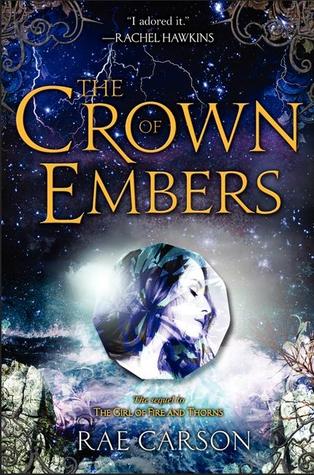
Waiting on The Crown of Embers by Rae Carson

Waiting on Wednesday is a weekly meme hosted by Breaking the Spine that spotlights any upcoming releases that we’re eagerly anticipating.

Release date: September 18, 2012

In the sequel to the acclaimed The Girl of Fire and Thorns, a seventeen-year-old princess turned war queen faces sorcery, adventure, untold power, and romance as she fulfills her epic destiny.

Elisa is the hero of her country. She led her people to victory against a terrifying enemy, and now she is their queen. But she is only seventeen years old. Her rivals may have simply retreated, choosing stealth over battle. And no one within her court trusts her-except Hector, the commander of the royal guard, and her companions. As the country begins to crumble beneath her and her enemies emerge from the shadows, Elisa will take another journey. With a one-eyed warrior, a loyal friend, an enemy defector, and the man she is falling in love with, Elisa crosses the ocean in search of the perilous, uncharted, and mythical source of the Godstone's power. That is not all she finds. A breathtaking, romantic, and dangerous second volume in the Fire and Thorns trilogy.
(Goodreads)

I recently read and loved Rae Carson's The Girl of Fire and Thorns. Check out my review. It thought it was generally a very imaginative and creative fantasy story, and there can never be too many of those! The advance reviews also seem pretty positive. Reading the first book so late after its publication actually seems to have been a good thing, since now I have barely any wait until the sequel is released!

What are you waiting on this week?
Read more »

September 11, 2012

Review: The Girl of Fire and Thorns by Rae Carson


The Girl of Fire and Thorns by Rae Carson
Published: 2011, Greenwillow
Series: Fire and Thorns, #1
Genre: Young Adult Fantasy
Source: Personal ebook
Goodreads · Amazon · Barnes & Noble


Alentín assured me that everyone has doubts. But it seems as though I am the only one without a single idea about what God wants from me. I am his bearer, and I understand nothing.


The Girl of Fire and Thorns has been highly recommended, and with the sequel coming out later this fall I figured that it was time to give this story a chance. After all, when have I ever been able to turn down a high fantasy with a strong female protagonist?

Elisa, the second princess of the kingdom of Oravalle, is one of the bearers of the Godstone. Chosen ones, whose importance has been marked by God himself, are incredibly rare. It is believed that one chosen to bear the Godstone has been given a mission assigned by God. Everyone seems to expect greatness from Elisa: her new husband, the people of Joya d'Arena, the people of Oravalle, and even those who live far across the reaches of the desert. Elisa is led to wonder, however, whether she'd ever be capable of such greatness, or whether she'd even die before completing her mission. Bearing a Godstone is not quite the honor most people assume it is.

The worldbuilding for The Girl of Fire and Thorns is very well done. It reminded me of a mix of Spanish and Italian cultures, through their languages in particular. I am a Hispanophile, so any book that refers to Spanish culture and language already gets major points by me, and it definitely made the book more unique than if Carson simply chose another typical English-inspired world. Although I love maps, I felt like I had a pretty good sense of the world without a map included. My favorite aspect of this book, however, is the religion by far. Fantasy books with solid and well-constructed religions are always a good thing for me. I don't necessarily care what sort of culture the religion derives from, but featuring a religious belief system is for me simply another way that shows the author really understands this world he or she has constructed. Whether or not everyone believes in the religion is irrelevant – just as in our world, people will have different beliefs. But no one can deny the power of strong religious systems and how they influence the lives of others. Elisa's religion is solidly built. She and many of the inhabitants of her world believe in a god who selects a chosen one every century, one who accepts prayers through fingerpricks on rose thorns, and one who is slowly drifting away from popularity. 

As a protagonist Elisa has so much potential. She is such an atypical protagonist: the overweight second royal daughter in a small kingdom who bears a Godstone in her navel, an inexplicable and unfathomable chosen one of her god. Because of her Godstone, Elisa is treated with reverence. But she, first and foremost, doesn't truly believe she is anything special or worthy of God's blessing. Over the course of the novel Elisa does undergo a dramatic character arc and changes into a much more confident young woman. I'll agree with other reviewers who have said that it is a tad problematic that Elisa's newfound confidence does seem to coincide with her weight loss, but relying on simply that argument is a huge simplification. I think her trial through the desert brings about many changes for Elisa – weight loss, but also the realization that life is much bigger than what she's known and she herself is a small part of a bigger picture. 

There are aspects here and there that seem to make Elisa's characterization a little troubling: after avoiding courts, conflicts, and politics for years she is suddenly able to offer up military strategy; she has not one but two love interests, neither of which rang particularly true to me; she struggles but ultimately seems to be successful in all that she seeks to accomplish. BUT. I think that Carson has created enough distinctive characteristics on Elisa's part that she cannot truly be considered a Mary Sue. She undergoes serious character growth. Both of her love interests aren't truly love interests and are nonessential in terms of her own growth and power. I can't really explain away Elisa's battle tactics knowledge, but I'm willing to suspend my disbelief for that. I do wish, however, that I had a better understanding of Elisa's initial lack of self-confidence that led to problems like her overeating. That issue wasn't addressed enough for me. I wanted to know why Elisa felt the need to overeat and remain in the shadows.

It would be a disservice to simply state that the novel is about Elisa's personal growth. Though she does grow, the story is so much bigger than that. Carson makes political and social commentaries about Elisa's world, and Elisa's growth is very much dependent on her ability to understand the problems that plague her society and work together with others to find solutions. Elisa is a character who is observant and empathetic. She stands in stark contrast to her husband's and her family's attitudes towards war and how it affects people. But I also loved seeing how the ongoing wars with the Invierne has affected marginal groups of people. It's always powerful to see/read/learn about how people are willing to interpret situations like wars in different ways depending on their personal investments. 

There were issues I had here and there with Elisa's characterization, but overall I enjoyed reading The Girl of Fire and Thorns and am definitely looking forward to reading The Crown of Embers.
Read more »

September 9, 2012

In My Mailbox #6

In My Mailbox is a weekly meme hosted by The Story Siren. It's a great way for book bloggers to showcase books and other literary things they've received over the past week.


Purchased:
Princess Academy (Princess Academy, #1) by Shannon Hale
Enna Burning (Books of Bayern, #2) by Shannon Hale
River Secrets (Books of Bayern, #3) by Shannon Hale
Forest Born (Books of Bayern, #4) by Shannon Hale
Yay for finding discounted Kindle books! All four of Shannon Hale's Books of Bayern were Kindle's Daily Deal yesterday for $1.99 each. I very much enjoyed The Goose Girl, my first experience with Hale. For such a good deal, I'm more than happy to continue with this series, even if the other ones aren't direct fairy-tale retellings. And since the sequel Palace of Stone was released last month, I guess Amazon also decided to have a few days where the price of the first book, Princess Academy, dropped dramatically. I love that my Kindle is now full of Shannon Hale!


Won:
The Fault in Our Stars by John Green
We meet again, John Green. And I'm sure this experience will be far better than the one I had while reading An Abundance of Katherines. I've tentatively had this book on my TBR list since the summer. I was super high on my library's wait list when I learned that I won a  copy of this through a giveaway hosted by Allison of Good Books and Good Wine. I'll definitely be picking this up to read this fall. I'm thinking this is an awesome first book to have won through a contest.

Library:
Daughter of Smoke and Bone (Daughter of Smoke and Bone, #1) by Laini Taylor
This book has consistently gotten rave reviews and, with the sequel coming out in a few months, I figured I'd better see what all the hype was about. And wow. After reading it I can say that this book merits every praise already out there and then some.
Coraline by Neil Gaiman
I am not a fan of the two Gaiman books I've read (Good Omens and Neverwhere). But I have heard good things about his children's books and the new YA lit book club I just joined is reading it for this month. I'm trying to read this book with an open mind and hoping that something will click with this book by Gaiman that just hasn't in the past.

Lots of reading ahead for me! What did you receive in your mailbox this week?
Read more »

September 7, 2012

Review: The Book of Lost Things by John Connolly


The Book of Lost Things by John Connolly
Published: 2006, Atria Books
Genre: Adult Fantasy 
Source: Library book
Goodreads · Amazon · Barnes & Noble


For in every adult there dwells the child that was, and in every child there lies the adult that will be.


I ended up reading this book due to the recommendation Courtney made months ago. She's much more into darker novels than I am, but this is a dark book that reworks well-known fairy tales. And after realizing that this is classified as adult fiction, there was simply no way I could refuse to read this.

The protagonist David has lived his life following a very strict set of self-imposed rules. He lives in England at the onset of World War II. His mother is gradually dying of cancer while his father is busy working long hours. Thus David does what he can to impose order and regularity upon his life, hoping that these rules will be enough to save his mother and return his life to a semblance of balance. But they're not, and soon after his mother's death, David's father remarries and they're relocated to his stepmother's house a slight distance from the city. Still reeling from his mother's death and the knowledge that his rules don't really guarantee security, David has a hard time adjusting to life with his stepmother Rose and new half-brother Georgie as his father works even later hours.

David’s mother instilled a love for stories, especially fairy tales, retellings, and epic fantasies – those stories that idealized life and the human condition. And so after her death David unsurprisingly turns even more inward and focuses on stories. And, strangely, those stories start to call out to him. David sees glimpses of an otherworldly man and the gap between his home’s sunken garden and the woods calls to him. No one believes anything David says, and so he takes it upon himself to follow the summonings to a new world. After arriving in this fairy world, David embarks on a journey to find his mother, whose voice has also been calling out to him. But along the way David comes to realize that nothing is as he imagined it, the world of fantasy a dangerous place indeed.

The Book of Lost Things features a fascinating portrayal of fractured fairy tales. In this world, Little Red Riding Hood seduced the wolf and created a whole new breed of half-human half-wolf beings. Childe Roland is a gay knight. Sleeping Beauty’s potential rescuers never leave her palace. The dwarfs are forced into taking care of Snow White. Rumpelstiltskin, known here as the Crooked Man, is a terrifying force to behold. I am sure there are tons of other fairy-tale references here that I completely missed, but it was interesting to see how Connolly created different, darker interpretations of those tales I did know. This is a world I enjoyed reading about, but definitely one I would never want to experience myself.

At its most basic level, this is a coming of age story, where David must learn to navigate life not only without his mother, but without any true parental influence. Time and again in this fantasy world David will form an alliance with an adult (mostly men), only to have it dissolve soon afterwards. For David to find out the truth about what happened to his mother and find a way home again using the king’s mysterious Book of Lost Things, he must learn to rely on himself. Besides dealing with the reconciliation between childhood and adulthood, the story also grapples with many other important questions throughout the book, such as how to deal with the cycle of life and death, and what it truly means to be human.

This is a book that is self-aware of the fact that it is a book. That is just awesome, because then the book is able to really examine different components of stories and what makes them resonate so powerfully for humans. Connolly constantly inserts what I consider to be his thoughts and opinions on the power of stories.

Stories wanted to be read, David’s mother would whisper. They needed it. It was the reason they forced themselves from their world into ours. They wanted us to give them life.

David’s adventures through the sunken garden into the fairy-tale world show that not only do stories influence us, but we have the potential to influence them. Time and again David either breaks the mold himself or helps others do something differently than expected. In this way, Connolly demonstrates the idea that not only do stories have the power to shape us, but we who experience stories through reading and our own imaginations also have the power to shape them.

I did not feel like I connected with any of the characters very well, not even David. This is always problematic for me as a reader, but in this case I think the story is about much more than David’s journey and growth (though fortunately he does undergo quite a bit of personal growth). Connolly instead poses greater questions and examines themes, which is more in line with what most fairy tales do anyway.

There are parts where the story lags a bit and I’m not sure if this is a book I’ll ever feel the need to reread, but I am glad I took the opportunity to read it. For those interested in seeing new and darker portrayals of fairy tales, I would recommend checking out this book.
Read more »

September 5, 2012

Waiting on Vessel by Sarah Beth Durst

Waiting on Wednesday is a weekly meme hosted by Breaking the Spine that spotlights any upcoming releases that we’re eagerly anticipating.

 Release date: September 11, 2012

In a desert world of sandstorms and sand-wolves, a teen girl must defy the gods to save her tribe in this mystical, atmospheric tale from the author of Drink, Slay, Love.

Liyana has trained her entire life to be the vessel of a goddess. The goddess will inhabit Liyana’s body and use magic to bring rain to the desert. But Liyana’s goddess never comes. Abandoned by her angry tribe, Liyana expects to die in the desert. Until a boy walks out of the dust in search of her.

Korbyn is a god inside his vessel, and a trickster god at that. He tells Liyana that five other gods are missing, and they set off across the desert in search of the other vessels. For the desert tribes cannot survive without the magic of their gods. But the journey is dangerous, even with a god’s help. And not everyone is willing to believe the trickster god’s tale.

The closer she grows to Korbyn, the less Liyana wants to disappear to make way for her goddess. But she has no choice: She must die for her tribe to live. Unless a trickster god can help her to trick fate—or a human girl can muster some magic of her own.

Well, judging person that I am, the blurb's credit to the author's previous book Drink, Slay, Love does not tempt me to read her works. But - this synopsis! That more than makes up for the lackluster feelings I have for a previous publication that is no doubt a parody of a book that, while enormously popular, also did not pique my interest. 

I am such a sucker for books with strong world-building and mythologies. I just love it when authors know their books' worlds well enough to not only create elaborate mythologies, but to have the worlds' beliefs and gods directly affect the characters. The premise of having certain people chosen to serve as vessels for their gods? And that one girl seems to have spent all these years being glorified only to not become a vessel? And the promising theme of self-sacrifice for the greater good? All good! I am super excited for this upcoming release!

What are you waiting on this week?
Read more »

September 4, 2012

Top Ten Books on My Fall TBR List

Top Ten Tuesday is a weekly meme created by the bloggers of The Broke and the Bookish. This week's topic is the top ten books on my fall TBR list. Well, I only ended up reading four of the books I mentioned for my summer TBR list. Let's see if I can at least read five of the books I mention below this time?

The Casual Vacancy by J.K. Rowling – J.K. Rowling is one of my favorite authors ever and I'm super excited to read this book (even if it does not feature a certain boy wizard). Also, this releases the day before my birthday. How awesome of a birthday present is that!?

House of Shadows by Rachel Neumeier – All the reviews I've read of this are overwhelmingly positive. This sounds like a fully fleshed-out world with great characters and political intrigue. 

For Darkness Shows the Stars by Diana Peterfreund – I just finished reading Jane Austen's Persuasion for the Austen in August read along. Now I'd love to read an adaptation while the original is still fresh in my mind. 

Eon and Eona by Alison Goodman – I've heard great things about this duology. I always love it when girls masquerade as boys. And, while I love the psuedo-Western Europe world of most high fantasies, I am eager to read about an Asian-inspired world.

Graceling, Fire, and Bitterblue by Kristin Cashore – These books are rollovers from my summer TBR list. I own Graceling and Fire and am getting close to the top of the waitlist for Bitterblue. I know of want to wait until I get Bitterblue so I can read all three in a row.

The Fault in Our Stars by John Green – Despite also being on my summer TBR list, I still haven't read this either. But now that I will own a physical copy of the book, there's absolutely no reason that I won't be able to read it within the next few months.

The Picture of Dorian Grey by Oscar Wilde – I got a free version for my Kindle but only managed to read about 40% because it was poorly formatted. I really want to read some Wilde and I think this is supposed to be one of his better books, so I'm either going to buy it or check it out of my library soon.

Let me know what's on your fall TBR list!
Read more »

September 2, 2012

Review: Grave Mercy by Robin LaFevers


Grave Mercy by Robin LaFevers
Published: 2012,
Series: His Fair Assassin, #1
Genre: Young Adult Historical Fantasy
Source: Library book


Why must the honorable die when so many dishonorable live?


Oh historical fantasy, how I have missed you. Although I am a huge fan of historical fiction, I haven't read any for a while. Historical fantasy is such an inventive genre, and I love how it combines two of my favorite genres. There's just something so exhilarating reading a book that intermixes the historical with the fantastical. After reading the synopsis of Robin LaFevers' Grave Mercy, I knew that this was something I had to read, and I am glad I did.

Grave Mercy takes place in the Duchy of Brittany, a small independent northern region of France, during the late fifteenth century. Ismae Rienne has not had a great childhood — she is the product of a failed abortion after her parents found her mother to be pregnant with the god of death's child. Already conscious about how little value her parents placed upon her life, Ismae also bears scars from the poisons that failed to kill her and is physically abused by her father. Her life does not seem like it will get any better through an arranged marriage, but hours after the wedding she is whisked away to a secret convent where nuns act as the handmaidens of Saint Mortain, the god of death. There Ismae finds a greater purpose in her life, learning how to serve Mortain through poison lore, seduction, weaponry, and how to administer the god's justice to (mainly male) victims. 

Ismae is eager to try her training out in the world, and her first and second assignments more or less go to plan. For her third assignment, however, Ismae finds herself far out of her league. She is asked to attend court as the mistress of Duval, a noble with a strong distrust for Ismae and her convent in general. At court she must uphold her duties of Mortain and protect both the duchess and independence of Brittany. 

Historical fantasies have the potential to be wonderful stories on so many levels, and Grave Mercy definitely upheld my expectations for the genre. LaFevers put in the research necessary to situate this novel within a very real place and era. It was a very visual book, and I loved all the descriptions of clothing, rooms, and the general atmosphere. I felt like I could imagine the culture at least a little, which is not easy to do. From my brief Wikipedia forays, I was able to confirm some historical aspects about Brittany that were present within the novel, as well as some information about its rulers (more on that later). I've always found it simply amazing when authors are able to bring to life certain events and settings and then infuse them with their own stories and characters. From this perspective, the book was very well done.

For the most part I liked Ismae's character. Ismae endured a very difficult life before the convent took her in, but once there Ismae doesn't seem to have quite the amount of struggles with self-worth and doubt that I would have expected. Part of the reason behind that may be that the novel skips ahead three years after Ismae's been in the convent for only a short time, but even past that I felt that there are aspects Ismae's character is lacking. But there are many, many aspects of Ismae that are just a delight to read: she's fierce, determined, and the daughter of death himself. And she does undergo a transformation and is able to question previously assumed knowledge. I always love a rational heroine willing to question the way things are.

The romance between Ismae and Duval, while expected, was also quite satisfying to read. For as much as I hate insta-love romances, I absolutely adore slow-burn ones where the characters start with enmity and misunderstanding. And, although Ismae and Duval have a common goal in seeing Anne crowned as the Duchess of Brittany, their relationship definitely fits this bill. Their relationship changes from one of misunderstanding and disgust (albeit one of mutual goals), to one where they really start to see the other person as a legitimate person, one with passions, personality, and, yes, flaws. Although I will say that this one pivotal scene that really establishes them in a relationship made me roll my eyes quite a bit. But they still form a very enjoyable relationship that I was willing to cheer for.

My main issue, however, is related to the romance I quite enjoyed reading. As a friend of mine recently explained, the novel is kind of divided. There's the beginning part where Ismae is at the convent and completes her first two missions, and that section is all about female empowerment. And then Ismae is taken to court to protect the Duchess of Brittany's claim to the throne, under the guise of being Duval's mistress. In this second half of the novel, female empowerment takes a back seat to many other aspects of the book. The political intrigue, for instance. And also the romance, which is a little unfortunate. Ismae has so much power in the eyes of her convent and her god, yet at some instances she inexplicably becomes much meeker and even second-guesses herself. I realize that she has been introduced into a world with which she's unfamiliar. But I still would have liked to see a little more awesome female empowerment in the second half than there actually is.

I usually don't really focus on secondary characters outside of love interest in my reviews, but I have to take a minute to appreciate a few of the wonderful secondary characters. Anne is probably my favorite character from this book. Anne of Brittany was also an actual historical person whose hand was indeed sought by many suitors. How awesome is that? I also enjoyed learning a little about Ismae's fellow acolytes Annith and Sybella. Based on the promotional blurb for Dark Triumph, it sounds as though Sybella is the protagonist. If that's so, then I'd love for Annith to be the protagonist of the final book. I'm curious to learn what mysterious mission Sybella had for the entirety of this book, and I'd love the chance to see what her inner mind is like. Annith was not in much of Grave Mercy, but I really liked what I've seen of her so far and since she was so incredibly sidelined in this book, it would be nice for her to have her own experiences. Although I enjoyed reading about Ismae, I am excited by the possibility of the following novels allowing us to further expand the world of Brittany and learn more about other characters.
  
There were a few issues I had here and there with Grave Mercy, but overall it was a very enjoyable read. I don't think it's possible for me to resist a well-constructed historical fantasy full of political intrigue and a slow-burning romance.
Read more »